
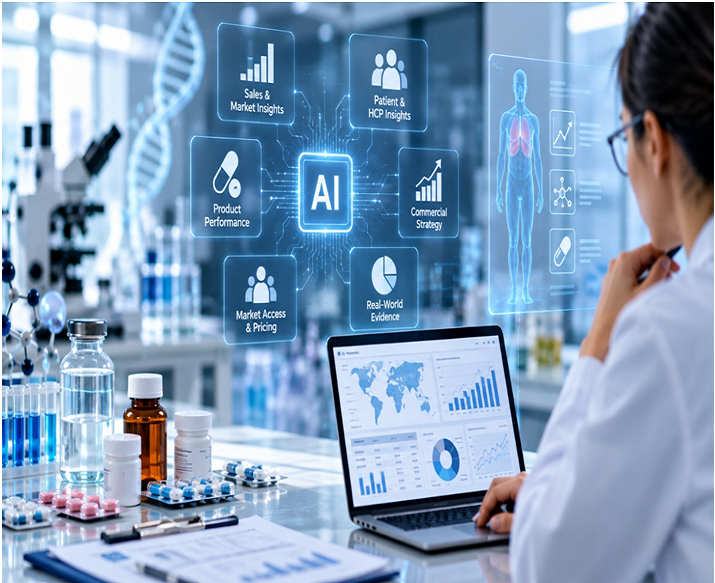
Why don’t AI insights translate into better decisions?
AI adoption is climbing across life sciences. Its effect on actual business decisions is not keeping pace.
An August 2026 survey conducted by Evaluate with BioPharma Dive showed that among 150 biopharmaceutical executives polled, 97% agreed that AI helps in decision-making but just 9% considered its influence transformational.
That gap is the whole problem. Nearly everyone trusts the insight. Almost no one can point to a decision it changed.
Therefore, when it comes to adopting AI in pharmaceuticals, the problem is not whether to adopt, but how to apply AI-derived insights to make business decisions. This can only be done based on the application of AI, the quality of data used, and the ability to implement the decision taken.
Where is AI improving decision-making in life sciences?
AI is present in research, development, production, and business. The work differs by function, but the aim holds: help teams weigh information and decide. These are the AI use cases for life sciences commercial teams and their counterparts upstream.
- Drug discovery and development. Analyze scientific literature, biological data, and experimental results to help researchers assess candidates and plan studies.
- Clinical development. Assess trial feasibility, find suitable patient populations, and review trial data to inform study design, with scientific teams keeping the call.
- Manufacturing and supply chain. Demand forecasting and anomaly detection flag supply constraints and production issues before they bite.
- Market intelligence. Read market trends, competitor moves, and past performance to test business scenarios.
- Commercial resource allocation. AI for life sciences companies compares territory opportunities and promotional spend, pointing to where added investment pays off most.
- HCP targeting and engagement. Combine HCP profiles, prescription patterns, and engagement history to prioritize physicians and decide the next action.
Commercial pharma is the clearest case of insight becoming a decision, and the clearest test of AI in commercial decision making. Teams choose where to spend, which HCPs to prioritize, and how to engage across channels. Each choice depends on reading market performance alongside individual HCP needs. That is the heart of how AI is transforming life sciences on the commercial side.
How does AI move commercial analytics into better HCP engagement?
Commercial decisions get hard when the inputs live in different places: CRM, prescription data, market research, digital channels. The harder part is closing the gap between that scattered data and an actual decision, which is where commercial analytics in the pharma industry earns its keep.
The 2026 picture shows how far execution lags intent. Deloitte’s 2026 Life Sciences Outlook Survey found only 22% of life sciences leaders have successfully scaled AI, and just 9% report significant returns. Plenty of activity reported at the top. Far less of it reaching the field in a form a rep can use.
That difference matters. A company can log strong engagement numbers while still missing what an individual HCP needs.
AI-enabled decision-making addresses this challenge by creating a relationship between the profile of the HCP and prescribing habits and interactions and hence helping identify who should be approached and how. That connected view is exactly what HCPPulse from Polestar Analytics is built to act on.
How does HCPPulse bring HCP intelligence to life sciences commercial teams?
Turning HCP analysis into field-level decisions means moving from broad segments to named priorities. That is where pharma commercial analytics becomes execution rather than reporting.
HCPPulse by Polestar Analytics makes use of CRM engagement data, prescribing pattern, and other healthcare-related information to build HCP profiles and target prioritization according to the quarter’s priorities. It suggests engagement routes and provides field teams with guidance within their current workflow. This is AI-powered commercial analytics for life sciences, pointed at the decision rather than the dashboard.
People stay in the loop. All suggestions go through evaluation by representatives and management prior to being adopted, and all suggestions have a history that can be attributed to their rationale.
A framework: the decision-to-outcome loop
A simple test for whether any AI use case earns its place. Walk four steps:
- Decision: Name the specific commercial decision, not the dataset.
- Data: Identify what’s needed to support it, and whether it’s clean enough to trust.
- Action: Confirm the output is something the field can act on, with a reason attached.
- Outcome: Define the metric, then measure what happened next.
If you can’t connect an analysis to a decision and track the result, you have an insight engine, not a decision engine.
Read More: How Magento Developers Can Help Scale Your Online Store Faster
FAQs About AI in Commercial Decision-Making
How would life science companies demonstrate that the use of AI led to better commercial decisions?
Name the decision before applying the model. Identify the business decision, select a metric, and measure its success after making the decision. According to the Evaluate 2026 results, there is 97% confidence compared to 9% transformational impact, and the reason for the difference is insights not applied to any decision.
How do you deploy AI for commercial decision making in pharma without failing a compliance review?
Build for traceability and human control from the start. Every recommendation should expose the question, the data, and the logic, and no proposal should reach a rep without approval. Run it in your own cloud environment with the data kept out of model training. In a regulated function, an untraceable recommendation is unusable, however good the output looks.
Why do strong HCP engagement metrics still miss the target, and how does AI commercial decision-making fix it?
Because activity volume and HCP relevance aren’t the same thing. Good coverage figures may rest on top of engagement that does not address the unique needs of individual prescribers. Commercial analytics through artificial intelligence technology bridges the gap by ranking healthcare professionals based on their relevance to present requirements and providing a rationale for each.